![[PukiWiki]](image/pukiwiki.png "[PukiWiki]")
富山県のホタルイカの身投げは、産卵行動や環境要因と密接に関連する現象であり、 その量の分析と予測は、生態学的理解の深化や気候変動の指標、さらに地域観光や漁 業資源管理における重要な意義を持っている。
1 過去のホタルイカ身投げデータと、その日の天気、気温、月齢、風などのデータを収集
2 身投げが起きやすい条件の分析、学習
3 ホタルイカの身投げ量の予測モデルの作成
4 身投げ量の予報を提供するWebサイトの作成

1. ホタルイカ掲示板というサイト(https://rara.jp/hotaruika-toyama/)の口コミからスクレイピングで口コミ内容を取得
2. その口コミ内容から、ホタルイカの身投げ量を5段階に分類し、0〜4の整数で数値化
3. その値の日毎の平均をその日の身投げ量とし、身投げ量、日付をjsonファイルに保存
2015年〜2025年まで10年分、それぞれ2〜5月の4ヶ月分の約1300日分のデータを収集した。過去の身投げ量以外の以下に記載したデータを収集するときは、この日付の日のデータを収集する。
気象庁の公式サイト(https://www.data.jma.go.jp/risk/obsdl/#)に、過去の天気、風、気温、降水量などのデータがあり、指定した場所、期間を指定すると、過去の天気などを CSV 形式でダウンロードできる.それをjsonデータに変換する。
API経由で潮位、潮の種類などが取得でき、その取得したデータをjsonファイルに保存する。(https://tide736.net/#google_vignette)
月齢は、西暦と日付から計算できる.日付ごとの月齢をjsonファイルにまとめる。
これらのjsonファイルを日付をキーにして一つのjsonファイルにまとめる。
目的変数(予測したい値):身投げ量(avg_amount)
説明変数(目的変数に影響を与える値):下記特徴量
データ分割:1220 日分のデータのうち85%を学習用、残りの15%をテスト用として使用
年、月、日、曜日、年の第何週
月齢は 0~29.53 日で周期的に変化するため、sin と cos で周期性を表現。
月齢 sin は「上弦の月」で最大(1)、「下弦の月」で最小(-1)。
月齢 cos は「新月」で最大(1)、満月で最小(-1)。
時間帯別(10-13 時、14-17 時、18-21 時、22-0 時、1-4 時)の平均気温も算出。
時間帯別の降水量合計も算出。降水の有無をバイナリ変数で表現。
潮型(若潮、長潮、小潮、中潮、大潮)を数値変換。
夜間(21 時~5 時)の満潮・干潮高(平均 / 最大 / 最小)。
気象・潮汐変数の 1 日前、2 日前の値。
目的変数(avg_amount)の 1 日前、2 日前、3 日間平均。
   import json
   import pandas as pd
   import numpy as np
   from sklearn.model_selection import TimeSeriesSplit, GridSearchCV
   from sklearn.metrics import mean_squared_error, mean_absolute_error, r2_score
   from sklearn.preprocessing import LabelEncoder, MinMaxScaler
   import matplotlib.pyplot as plt
   import seaborn as sns
   import lightgbm as lgb
   import holidays
   # イベント日リスト(YYYY-MM-DD形式で実際のイベント日を記入)
   EVENT_DATES = [
       "2023-03-25", "2023-04-10", "2023-04-20"
   ]
jp_holidays = holidays.country_holidays("JP")
   DIRECTION_MAP = {
       '北': 0, '北北東': 1, '北東': 2, '東北東': 3, '東': 4, '東南東': 5, '南東': 6, '南南東': 7,
       '南': 8, '南南西': 9, '南西': 10, '西南西': 11, '西': 12, '西北西': 13, '北西': 14, '北北西': 15
   }
   TIDE_TYPE_MAP = {'若潮': 0, '長潮': 1, '小潮': 2, '中潮': 3, '大潮': 4}
   def direction_to_radian(direction):
       idx = DIRECTION_MAP.get(direction)
       if idx is None:
           return np.nan
       return 2 * np.pi * idx / 16
   def mean_wind_direction(directions):
       radians = np.array([direction_to_radian(d) for d in directions if d in DIRECTION_MAP])
       if len(radians) == 0:
           return np.nan
       sin_sum = np.sin(radians).mean()
       cos_sum = np.cos(radians).mean()
       mean_rad = np.arctan2(sin_sum, cos_sum)
       if mean_rad < 0:
           mean_rad += 2 * np.pi
       return int(np.round(mean_rad * 16 / (2 * np.pi))) % 16
   def safe_float(x):
       try:
           return float(x)
       except Exception:
           return np.nan
   def is_wind_night_time(time_str):
       try:
           hour = int(time_str.split(' ')[1].split(':')[0])
           return (20 <= hour <= 23) or (0 <= hour <= 4)
       except Exception:
           return False
   def is_temp_precip_night_time(time_str):
       try:
           hour = int(time_str.split(' ')[1].split(':')[0])
           return (10 <= hour <= 23) or (0 <= hour <= 4)
       except Exception:
           return False
   def is_night_tide_time(time_str):
       try:
           hour = int(time_str.split(':')[0])
           return (21 <= hour <= 23) or (0 <= hour <= 5)
       except Exception:
           return False
   def get_time_period(hour):
       if 10 <= hour <= 13:
           return '10_13'
       elif 14 <= hour <= 17:
           return '14_17'
       elif 18 <= hour <= 21:
           return '18_21'
       elif hour in [22, 23, 0]:
           return '22_0'
       elif 1 <= hour <= 4:
           return '1_4'
       else:
           return None
   all_rows = []
   # JSONファイルのパスを適切に設定してください
   with open('avg_amount_moon_temperature_wind_precipitation_tide_2.json', encoding='utf-8') as f:
       data = json.load(f)
   for entry in data:
       date = entry['date']
       avg_amount = safe_float(entry['avg_amount'])
       moon_age = safe_float(entry['moon_age'])
       try:
           date_dt = pd.to_datetime(date, format='%Y/%m/%d')
           year = date_dt.year
           month = date_dt.month
           day = date_dt.day
           weekday = date_dt.weekday()
           date_str_ymd = date_dt.strftime('%Y-%m-%d')
           week_of_year = date_dt.isocalendar().week
           week_of_month = (date_dt.day - 1) // 7 + 1
           day_of_year = date_dt.dayofyear
       except Exception:
           year = np.nan
           month = np.nan
           day = np.nan
           weekday = np.nan
           date_str_ymd = None
           week_of_year = np.nan
           week_of_month = np.nan
           day_of_year = np.nan
       is_weekend = 1 if weekday in [5, 6] else 0
       is_holiday = 1 if date_str_ymd in jp_holidays else 0
       is_event = 1 if date_str_ymd in EVENT_DATES else 0
       temp_periods = {'10_13': [], '14_17': [], '18_21': [], '22_0': [], '1_4': []}
       prec_periods = {'10_13': [], '14_17': [], '18_21': [], '22_0': [], '1_4': []}
       temps = []
       for d in entry.get('temperature_data', []):
           temp = safe_float(d.get('average_temperature(℃)'))
           time_str = d.get('time', '')
           if temp is not None and temp != '' and time_str:
               try:
                   hour = int(time_str.split(' ')[1].split(':')[0])
               except Exception:
                   continue
               if is_temp_precip_night_time(time_str):
                   temps.append(temp)
               period = get_time_period(hour)
               if period:
                   temp_periods[period].append(temp)
       temperature_mean = np.nanmean(temps) if temps else np.nan
       temperature_max = np.nanmax(temps) if temps else np.nan
       temperature_min = np.nanmin(temps) if temps else np.nan
       temperature_std = np.nanstd(temps) if temps else np.nan
       precs = []
       for d in entry.get('precipitation_data', []):
           prec = safe_float(d.get('precipitation_totals(mm)'))
           time_str = d.get('time', '')
           if prec is not None and prec != '' and time_str:
               try:
                   hour = int(time_str.split(' ')[1].split(':')[0])
               except Exception:
                   continue
               if is_temp_precip_night_time(time_str):
                   precs.append(prec)
               period = get_time_period(hour)
               if period:
                   prec_periods[period].append(prec)
       precipitation_sum = np.nansum(precs) if precs else 0
       precipitation_binary = 1 if precipitation_sum > 0 else 0
       temp_period_features = {}
       prec_period_features = {}
       for p in temp_periods:
           temp_period_features[f'temperature_mean_{p}'] = np.nanmean(temp_periods[p]) if temp_periods[p] else np.nan
       for p in prec_periods:
           prec_period_features[f'precipitation_sum_{p}'] = np.nansum(prec_periods[p]) if prec_periods[p] else 0
       wind_speeds = [safe_float(d.get('average_wind_speed_m_s')) for d in entry.get('wind_data', [])
                   if d.get('average_wind_speed_m_s') not in [None, '']
                   and is_wind_night_time(d.get('time',''))]
       wind_speed_mean = np.nanmean(wind_speeds) if wind_speeds else np.nan
       wind_speed_max = np.nanmax(wind_speeds) if wind_speeds else np.nan
       wind_speed_min = np.nanmin(wind_speeds) if wind_speeds else np.nan
       wind_speed_std = np.nanstd(wind_speeds) if wind_speeds else np.nan
       wind_dirs = [d.get('wind_direction') for d in entry.get('wind_data', [])
                   if d.get('wind_direction', '') != '' and is_wind_night_time(d.get('time',''))]
       wind_direction_mean = mean_wind_direction(wind_dirs) if wind_dirs else np.nan
       tide_type_str = entry.get('tide_data_night', {}).get('tide_type', None)
       tide_type_num = TIDE_TYPE_MAP.get(tide_type_str, np.nan)
       high_tides = entry.get('tide_data_night', {}).get('high_tide', [])
       night_high_tides = [
           safe_float(ht.get('tide_height_cm')) for ht in high_tides
           if ht.get('time') and is_night_tide_time(ht['time'])
       ]
       high_tide_height_mean = np.nanmean(night_high_tides) if night_high_tides else np.nan
       high_tide_height_max = np.nanmax(night_high_tides) if night_high_tides else np.nan
       high_tide_height_min = np.nanmin(night_high_tides) if night_high_tides else np.nan
       low_tides = entry.get('tide_data_night', {}).get('low_tide', [])
       night_low_tides = [
           safe_float(lt.get('tide_height_cm')) for lt in low_tides
           if lt.get('time') and is_night_tide_time(lt['time'])
       ]
       low_tide_height_mean = np.nanmean(night_low_tides) if night_low_tides else np.nan
       low_tide_height_max = np.nanmax(night_low_tides) if night_low_tides else np.nan
       low_tide_height_min = np.nanmin(night_low_tides) if night_low_tides else np.nan
       all_rows.append({
           'date': date,
           'year': year,
           'month': month,
           'day': day,
           'avg_amount': avg_amount,
           'moon_age': moon_age,
           'weekday': weekday,
           'week_of_year': week_of_year,
           'week_of_month': week_of_month,
           'day_of_year': day_of_year,
           'is_weekend': is_weekend,
           'is_holiday': is_holiday,
           'is_event': is_event,
           'temperature_mean': temperature_mean,
           'temperature_max': temperature_max,
           'temperature_min': temperature_min,
           'temperature_std': temperature_std,
           'precipitation_sum': precipitation_sum,
           'precipitation_binary': precipitation_binary,
           'wind_speed_mean': wind_speed_mean,
           'wind_speed_max': wind_speed_max,
           'wind_speed_min': wind_speed_min,
           'wind_speed_std': wind_speed_std,
           'wind_direction_mean': wind_direction_mean,
           'tide_type_num': tide_type_num,
           'high_tide_height_mean': high_tide_height_mean,
           'high_tide_height_max': high_tide_height_max,
           'high_tide_height_min': high_tide_height_min,
           'low_tide_height_mean': low_tide_height_mean,
           'low_tide_height_max': low_tide_height_max,
           'low_tide_height_min': low_tide_height_min,
           **temp_period_features,
           **prec_period_features
       })
   df = pd.DataFrame(all_rows)
   df['date'] = pd.to_datetime(df['date'], format='%Y/%m/%d')
   df = df[df['date'].dt.month >= 2]
df = df.sort_values('date').reset_index(drop=True)
   df['moon_age_sin'] = np.sin(2 * np.pi * df['moon_age'] / 29.53)
   df['moon_age_cos'] = np.cos(2 * np.pi * df['moon_age'] / 29.53)
   df['moon_age'] = df['moon_age'].ffill()
   df['year'] = df['year'].fillna(df['year'].mode()[0])
   df['month'] = df['month'].fillna(df['month'].mode()[0])
   df['day'] = df['day'].fillna(df['day'].mode()[0])
   df['week_of_year'] = df['week_of_year'].fillna(df['week_of_year'].mode()[0])
   df['week_of_month'] = df['week_of_month'].fillna(df['week_of_month'].mode()[0])
   df['day_of_year'] = df['day_of_year'].fillna(df['day_of_year'].mode()[0])
   for c in ['temperature_mean','temperature_max','temperature_min','temperature_std']:
       df[c] = df[c].ffill()
   df['precipitation_sum'] = df['precipitation_sum'].fillna(0)
   df['precipitation_binary'] = df['precipitation_binary'].fillna(0)
   for c in ['wind_speed_mean','wind_speed_max','wind_speed_min','wind_speed_std']:
       df[c] = df[c].ffill()
   df['wind_direction_mean'] = df['wind_direction_mean'].ffill()
   df['tide_type_num'] = df['tide_type_num'].fillna(df['tide_type_num'].mode()[0])
   for c in [
       'high_tide_height_mean','high_tide_height_max','high_tide_height_min',
       'low_tide_height_mean','low_tide_height_max','low_tide_height_min'
   ]:
       df[c] = df[c].fillna(0)
   for c in ['weekday','is_weekend','is_holiday','is_event']:
       df[c] = df[c].fillna(0)
   for p in ['10_13', '14_17', '18_21', '22_0', '1_4']:
       df[f'temperature_mean_{p}'] = df[f'temperature_mean_{p}'].ffill()
       df[f'precipitation_sum_{p}'] = df[f'precipitation_sum_{p}'].fillna(0)
   le = LabelEncoder()
   df['wind_direction_encoded'] = le.fit_transform(df['wind_direction_mean'])
   for win in [3]:
       df[f'temperature_mean_{win}d_mean'] = df['temperature_mean'].rolling(window=win, min_periods=1).mean().shift(1)
       df[f'precipitation_sum_{win}d_sum'] = df['precipitation_sum'].rolling(window=win, min_periods=1).sum().shift(1)
df['avg_amount_lag1'] = df['avg_amount'].shift(1)
   ### 変更点 ### 潮関連のデータをラグ特徴量のリストから除外
   lag_cols = [
       'moon_age', 'moon_age_sin', 'moon_age_cos', 'temperature_mean', 'temperature_max', 'temperature_min',
       'temperature_std', 'precipitation_sum', 'precipitation_binary', 'wind_speed_mean', 'wind_speed_max', 'wind_speed_min',
       'wind_speed_std', 'wind_direction_encoded',
       'day_of_year',
   ]
   for col in lag_cols:
       df[f'{col}_lag1'] = df[col].shift(1)
       df[f'{col}_lag2'] = df[col].shift(2)
df = df.dropna().reset_index(drop=True)
   features = [
       'year', 'month',
       'week_of_month',
       'day_of_year',
       'moon_age', 'moon_age_sin', 'moon_age_cos',
       'weekday', 'is_weekend', 'is_holiday', 'is_event',
       'temperature_mean', 'temperature_max', 'temperature_min', 'temperature_std',
       'precipitation_sum', 'precipitation_binary',
       'wind_speed_mean', 'wind_speed_max', 'wind_speed_min', 'wind_speed_std',
       'wind_direction_encoded',
       'tide_type_num',
       'high_tide_height_mean','high_tide_height_max','high_tide_height_min',
       'low_tide_height_mean','low_tide_height_max','low_tide_height_min',
       'avg_amount_lag1',
       'temperature_mean_3d_mean',
       'precipitation_sum_3d_sum'
   ]
   features += [f'temperature_mean_{p}' for p in ['10_13', '14_17', '18_21', '22_0', '1_4']]
   features += [f'precipitation_sum_{p}' for p in ['10_13', '14_17', '18_21', '22_0', '1_4']]
   ### 変更点 ### lag_colsに対応して特徴量リストを更新
   features += [f"{col}_lag1" for col in lag_cols]
   features += [f"{col}_lag2" for col in lag_cols]
   X = df[features]
   y = df['avg_amount'].values.reshape(-1, 1)
   scaler_X = MinMaxScaler()
   scaler_y = MinMaxScaler()
   X_scaled = scaler_X.fit_transform(X)
   y_scaled = scaler_y.fit_transform(y)
   tscv = TimeSeriesSplit(n_splits=5)
   param_grid = {
       'num_leaves': [15, 31, 63],
       'learning_rate': [0.01, 0.05, 0.1],
       'n_estimators': [100, 300, 500],
       'random_state': [42]
   }
   lgb_model = lgb.LGBMRegressor()
   gs = GridSearchCV(lgb_model, param_grid, scoring='r2', cv=tscv, n_jobs=-1, verbose=1)
   gs.fit(X_scaled, y_scaled.ravel())
   best_model = gs.best_estimator_
   best_params = gs.best_params_
   print("Best Params:", best_params)
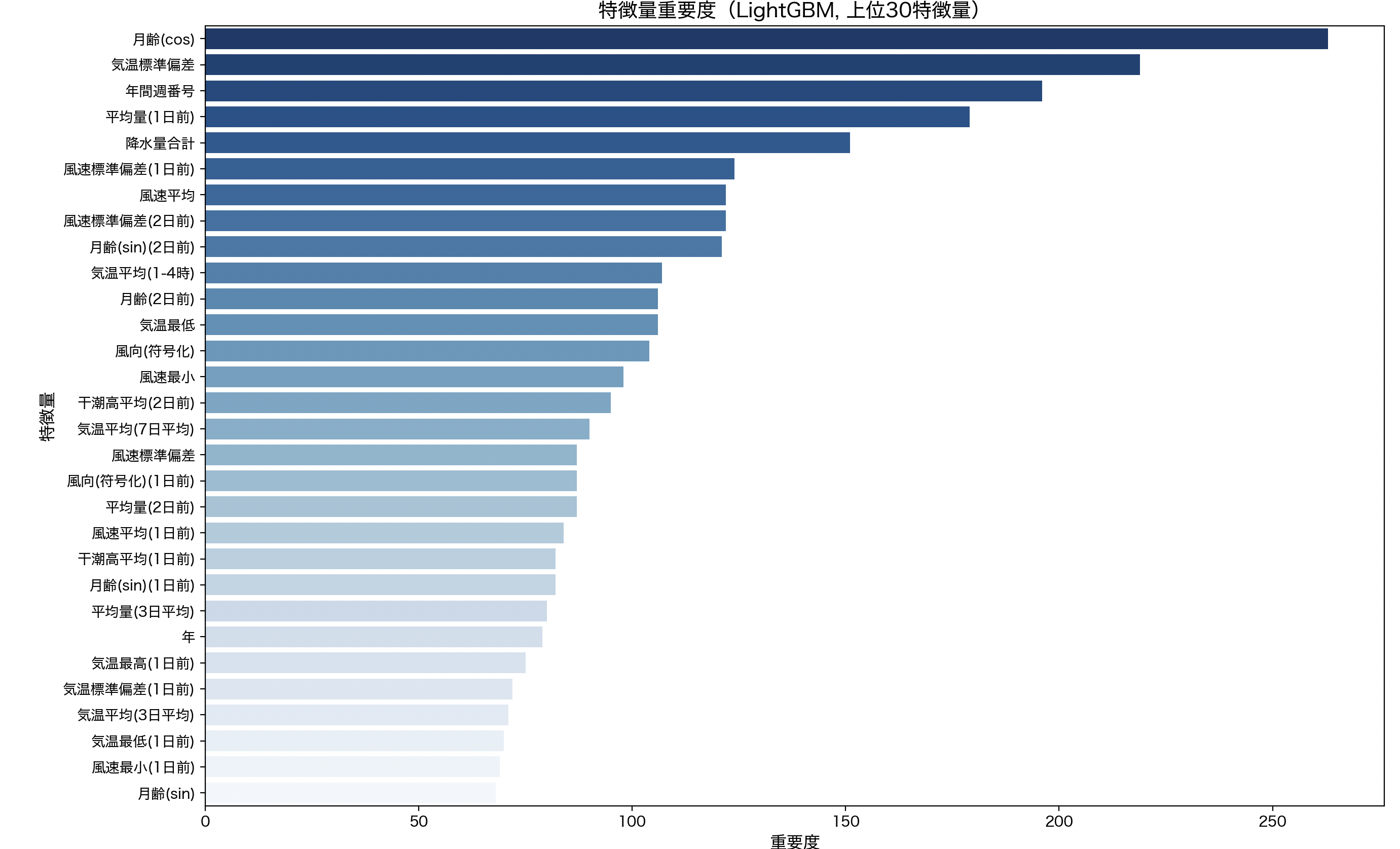
   feature_importance = pd.DataFrame({
       'feature': features,
       'importance': best_model.feature_importances_
   }).sort_values('importance', ascending=False)
print(f"\n重要度0の特徴量: {feature_importance[feature_importance['importance'] == 0]['feature'].tolist()}\n")
   ### 変更点 ### 重要度が10以上の特徴量を選択
   selected_features = feature_importance[feature_importance['importance'] >= 10]['feature'].tolist()
   print(f"選択された特徴量の数: {len(selected_features)}")
   print(f"選択された特徴量: {selected_features}\n")
   # 選択された特徴量に目的変数そのものが含まれていないか確認
   if 'avg_amount' in selected_features:
       print("警告:選択された特徴量に 'avg_amount' が含まれています。除外します。")
       selected_features.remove('avg_amount')
   X_sel = df[selected_features]
   scaler_X_sel = MinMaxScaler()
   X_sel_scaled = scaler_X_sel.fit_transform(X_sel)
   test_size = int(len(df) * 0.15)
   X_train, X_test = X_sel_scaled[:-test_size], X_sel_scaled[-test_size:]
   y_train, y_test = y_scaled[:-test_size], y_scaled[-test_size:]
   best_model.fit(X_train, y_train.ravel())
   y_pred = best_model.predict(X_test)
   mse = mean_squared_error(y_test, y_pred)
   mae = mean_absolute_error(y_test, y_pred)
   r2 = r2_score(y_test, y_pred)
   ### 変更点 ### 評価指標のタイトルを更新
   print("\n=== モデル評価(正規化後, 重要度10以上の特徴量のみ) ===")
   print("平均二乗誤差 (MSE):", mse)
   print("平均絶対誤差 (MAE):", mae)
   print("決定係数 (R²):", r2)
   feature_importance_sel = pd.DataFrame({
       'feature': selected_features,
       'importance': best_model.feature_importances_
   }).sort_values('importance', ascending=False)
   ### 変更点 ### 特徴量重要度のタイトルを更新
   print("\n特徴量の重要度(重要度10以上の特徴量のみ):\n", feature_importance_sel)
   plt.figure(figsize=(10, 12))
   sns.barplot(x='importance', y='feature', data=feature_importance_sel)
   ### 変更点 ### グラフのタイトルを更新
   plt.title('Feature Importance (LightGBM, Importance >= 10)')
   plt.tight_layout()
   plt.show()
   plt.figure(figsize=(8, 6))
   plt.plot(y_test, label='True (normalized)')
   plt.plot(y_pred, label='Pred (normalized)')
   plt.legend()
   ### 変更点 ### グラフのタイトルを更新
   plt.title('Prediction vs True (Normalized, Importance >= 10)')
   plt.show()
   y_test_inv = scaler_y.inverse_transform(y_test.reshape(-1, 1))
   y_pred_inv = scaler_y.inverse_transform(y_pred.reshape(-1, 1))
   plt.figure(figsize=(8, 6))
   plt.plot(y_test_inv, label='True (original scale)')
   plt.plot(y_pred_inv, label='Pred (original scale)')
   plt.legend()
   ### 変更点 ### グラフのタイトルを更新
   plt.title('Prediction vs True (Original Scale, Importance >= 10)')
   plt.show()
from joblib import dump
   # すでに学習済みのモデル・スケーラー・特徴量リストがある前提
   dump(best_model, 'best_model.joblib')
   dump(scaler_X_sel, 'scaler_X_sel.joblib')
   dump(scaler_y, 'scaler_y.joblib')
   import pickle
   with open('selected_features.pkl', 'wb') as f:
       pickle.dump(selected_features, f)
・平均二乗誤差 (MSE): 0.0179
・平均絶対誤差 (MAE): 0.0990
・決定係数 (R²): 0.4191
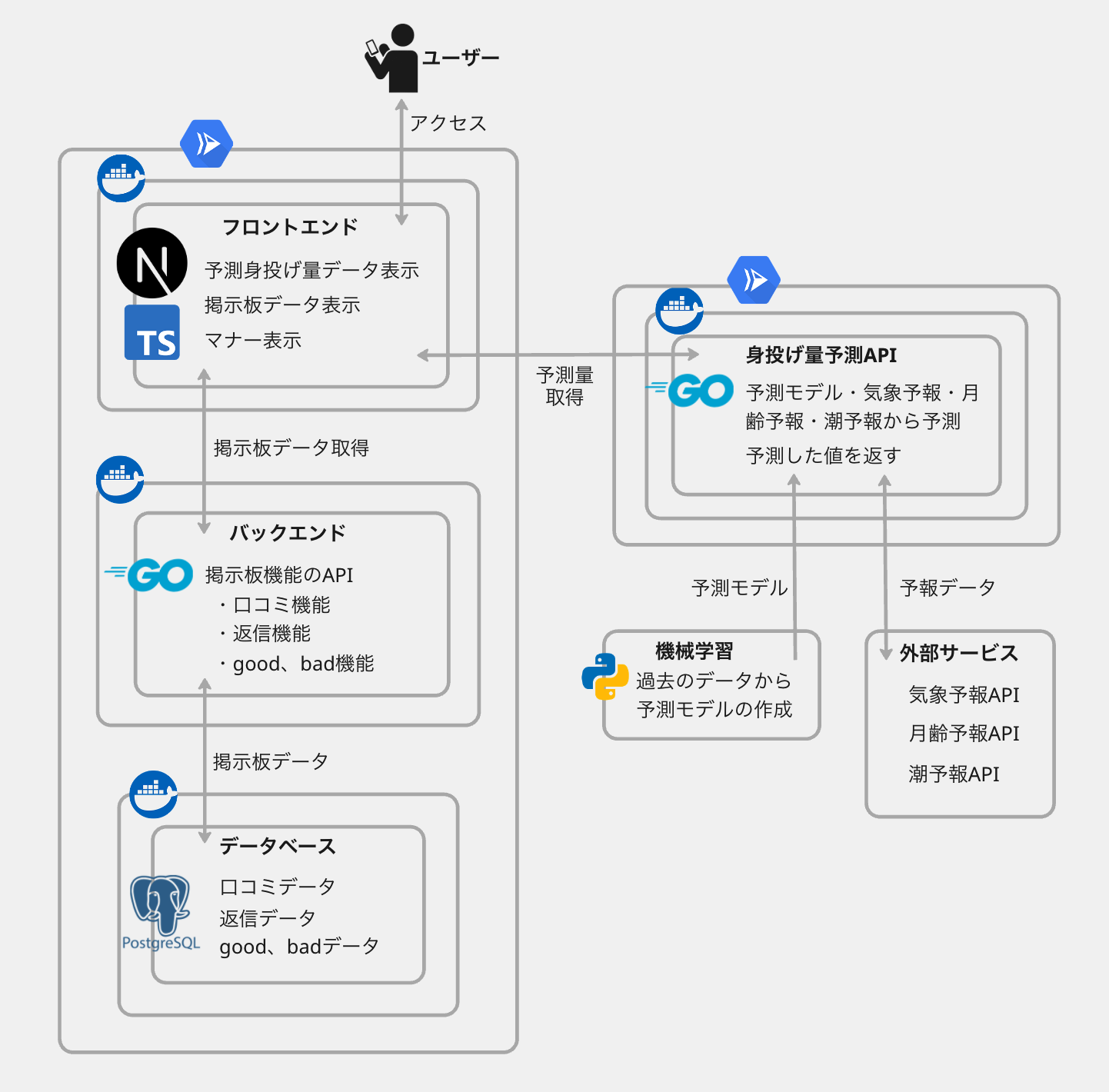
Webサイトのリポジトリ:https://github.com/yuchi1128/hotaruika-bakuwaki-forecast
ターミナルで
  # コードをローカルに持ってくる
  git clone https://github.com/yuchi1128/hotaruika-bakuwaki-forecast.git
  # Dockerコンテナの起動(自動でフロントエンド、バックエンド、データベースのサ ーバーが起動されます)
  docker-compose up -d --build
・ホタルイカの身投げ量を 1 週間後まで予測して表示
・その日の天気や月齢、潮の満ち引きなどの情報を表示
・ホタルイカ掬いでの注意点を掲載
・口コミ機能(good・bad、返信)
・フロントエンド:TypeScript(Next.js)
・バックエンド:Go
・データベース:PostgreSQL
・インフラ:Docker
・ホスティング:GCP(Cloud Run)